




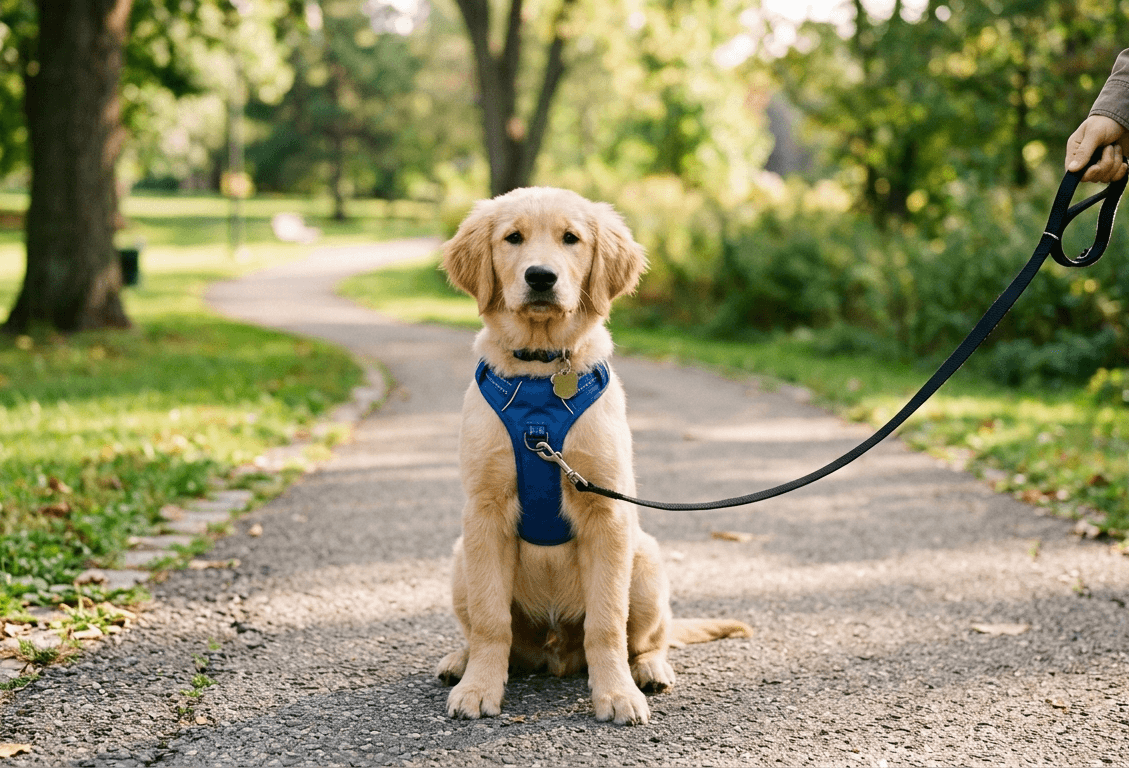
Leash training a stubborn puppy is a test of patience, not strength. Most owners fail because they use the wrong equipment or allow the dog to “win” by pulling them toward a distraction. To rank your puppy’s behavior at the top, you must use a systematic, reward-based approach.
Follow this zero-fluff guide to mastering the walk.
1. Eliminate the Retractable Leash
Professional trainers avoid retractable leashes because they provide inconsistent tension, which confuses a puppy. For a stubborn dog, you need a heavy-duty, fixed-length nylon lead.
- Recommended: Max and Neo Stainless Steel Chain Dog Leash (The double-handle version is best for the market as it offers a “traffic handle” for tight control).
2. Implement a Front-Clip Harness
If your puppy is a “puller,” a standard collar can put dangerous pressure on their trachea. A front-clip harness changes the leverage point, redirecting the puppy’s momentum back toward you.
- Top Choice: PetSafe Easy Walk Dog Harness. This is a staple in American households because it stops pulling without causing pain or restricting movement.
3. High-Value Reinforcement (The Currency)
Standard dry kibble is rarely enough to keep a puppy’s focus outdoors. You need soft, high-scent treats that can be consumed quickly so you don’t break the flow of the walk.
- Amazon Favorite: Zuke’s Mini Naturals Training Dog Treats. They are small (3 calories each), making them perfect for the high-repetition training required for stubborn breeds.
4. Use a Treat Pouch for Split-Second Timing
In dog training, timing is everything. If you are fumbling in your pocket for a treat, you miss the “teaching moment.” A clip-on pouch ensures you reward the puppy the instant the leash goes slack.
- Recommended Gear: PetSafe Sport Treat Pouch. It features a spring-loaded hinge that stays open or snaps shut instantly.
5. The “Be a Statue” Technique
When the puppy pulls and the leash goes tight, you must stop moving immediately. Do not yank the leash back; simply stop. The walk only continues (the “Green Light”) when the puppy turns back to look at you and the leash becomes loose.
6. Introduce “Marking” with a Clicker
A clicker creates a distinct sound that marks the exact behavior you like. It is much more effective than a verbal “Good Boy” because it is a consistent, non-emotional sound.
- Best Seller: EcoCity Dog Training Clicker with Wrist Strap. These come in multi-packs, which is great for keeping one in the car and one by the front door.
7. Short Sessions, High Frequency
A stubborn puppy has a short attention span. Instead of one long 30-minute walk, do five 5-minute sessions. Training on your driveway or sidewalk before heading to a high-distraction park will yield 10x faster results.
Technical Checklist for Owners
| Product Type | Why You Need It | Top Recommendation |
| Control | Prevents pulling safely | PetSafe Easy Walk Harness |
| Feedback | Direct communication | Max and Neo Fixed Leash |
| Motivation | High-scent reward | Zuke’s Mini Naturals |
| Utility | Rapid reward delivery | PetSafe Sport Pouch |
Frequently Asked Questions (FAQs)
1. How long does it take to leash train a stubborn puppy?
Every puppy is different, but with consistent daily training, most owners see a significant improvement within 2 to 4 weeks. For stubborn breeds, the key is high-frequency, short sessions (5–10 minutes) rather than one long walk.
2. At what age should I start leash training?
You can start as early as 8 weeks old. Begin indoors in a familiar, distraction-free environment to help your puppy build confidence with the gear before tackling the sights and sounds of the outdoors.
3. Why does my puppy sit or lay down and refuse to move on the leash?
This is often a sign of fear or being overwhelmed by the environment. Do not pull them. Instead, use Zuke’s Mini Naturals to lure them forward and reward even a single step in the right direction.
4. Are slip leads or choke collars good for stubborn puppies?
No. These can cause physical harm to a developing puppy’s neck. A PetSafe Easy Walk Harness is a much safer and more effective alternative for controlling a strong puller without the risk of injury.
5. What should I do if my puppy keeps biting the leash?
Leash biting is usually a sign of playfulness or frustration. Try a chain-based lead like the Max and Neo Stainless Steel Leash, as puppies generally find the texture of metal less appealing to chew than nylon.
Conclusion
Leash training a stubborn puppy is less about physical dominance and more about strategic consistency. By swapping out ineffective gear—like retractable leashes—for professional-grade tools such as a front-clip harness and high-value rewards, you change the dynamic of the walk from a struggle to a partnership.
Success won’t happen overnight, but by following the “Red Light, Green Light” rule and keeping your sessions short and positive, you will eventually enjoy the stress-free walks you’ve been dreaming of. Ready to get started? Grab your Training Clicker and a bag of treats, and head out for your first 5-minute session today.