




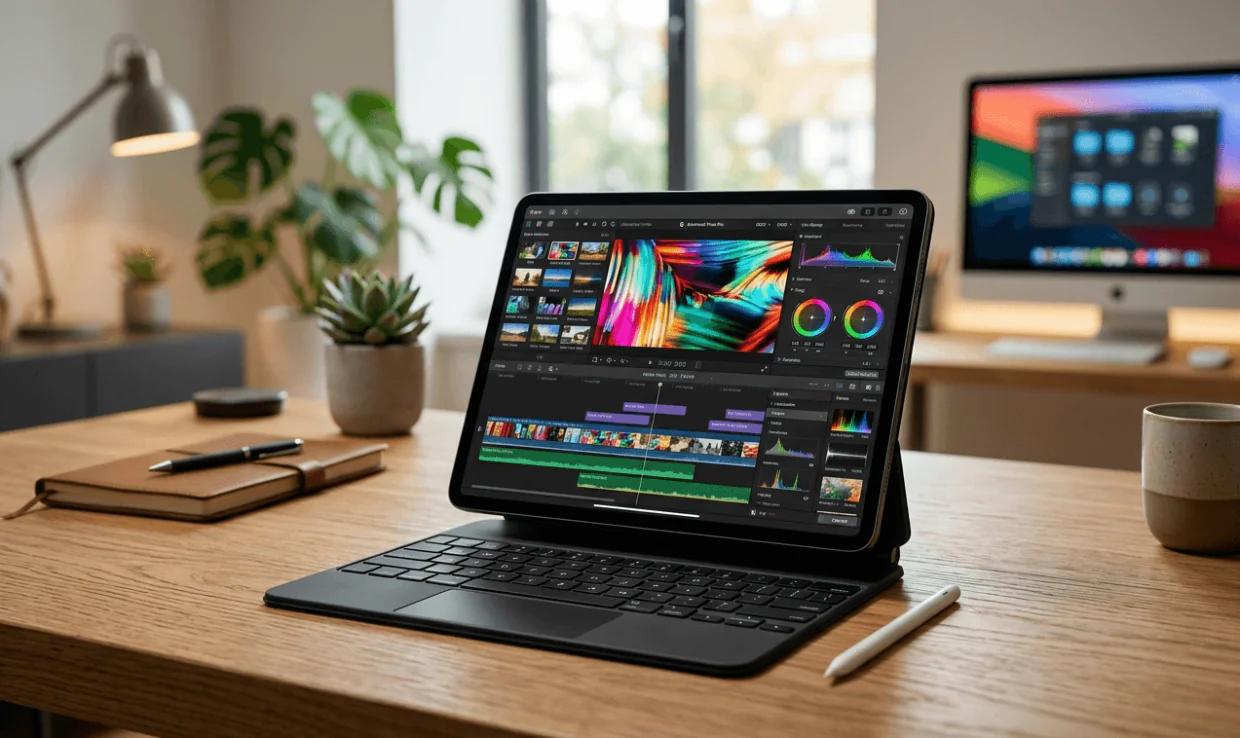
The 2025 Apple iPad Pro featuring the new M5 silicon introduces a definitive hardware shift in Apple’s tablet architecture. This review examines the 13-inch Wi-Fi + Cellular model equipped with 256GB of storage and the Space Black finish. The primary focus of this analysis is computing capability, display hardware, and the overall value proposition for enterprise and creative professionals.
Core Hardware: The Apple M5 Silicon Architecture
The defining component of this hardware generation is the Apple M5 chip, built on the TSMC N3P process. The base 256GB model utilizes a 9-core CPU (3 performance cores, 6 efficiency cores) paired with a 10-core GPU.
Critical hardware upgrades over the M4 generation include:
- Base RAM Allocation: Apple has eliminated the 8GB memory threshold. The 256GB model now natively includes 12GB of LPDDR5X-9600 RAM, drastically reducing application swap memory dependency during heavy multitasking.
- Memory Bandwidth: Increased to 153 GB/s (up from 120 GB/s).
- Neural Processing: The 16-core Neural Engine includes dedicated Neural Accelerators, directly optimizing on-device AI computational tasks and machine learning workflows within iPadOS 26.
Display Technology: Ultra Retina XDR
The 13-inch Ultra Retina XDR display utilizes a double-stacked Tandem OLED panel structure. Operating at a 2752 x 2064 resolution (264 ppi), the display provides absolute black levels and pixel-perfect localized contrast.
- Brightness Metrics: Sustains 1000 nits for SDR and full-screen HDR content, peaking at 1600 nits for specific HDR highlights. It also features a new 1-nit minimum brightness for low-light environments.
- Refresh Rate: Integrates ProMotion technology with adaptive refresh rates scaling dynamically from 10Hz to 120Hz based on UI interaction and content.
Connectivity and Power Delivery
Wireless protocols have been upgraded to Wi-Fi 7 (802.11be) with 2×2 MIMO and Bluetooth 6.0 LE. The cellular models rely exclusively on advanced eSIM infrastructure for 5G connectivity, dropping physical SIM support entirely for enhanced security.
Power is supplied by a 38.99-watt-hour battery. While the total capacity remains identical to the prior generation, the efficiency of the M5 chip extends operational runtime in continuous load tests. Fast-charge functionality now enables a 0-50% battery recovery in approximately 30 minutes when utilizing a 60W or higher USB-C power adapter.
Frequently Asked Questions (FAQs)
Is the M5 iPad Pro 13-inch significantly faster than the M4 model?
Yes, the M5 chip architecture provides a 15-20% increase in CPU performance and a 25% boost in memory bandwidth (up to 153 GB/s). For professional workflows like 4K video rendering and 3D modeling, the M5 offers a noticeable reduction in export times and smoother multitasking due to the upgraded 12GB base RAM.
Does the 2025 iPad Pro support physical SIM cards?
No. Starting with the 2024/2025 Pro lineup, Apple has transitioned exclusively to eSIM technology for cellular models. This enhances security and allows for easier switching between international data plans, but it does mean you cannot insert a physical nano-SIM.
What is the benefit of the Tandem OLED display on the 13-inch model?
The Tandem OLED technology stacks two OLED panels to achieve higher brightness levels (1000 nits sustained) and better longevity compared to single-layer OLEDs. It provides “XDR” performance with absolute blacks, 2,000,000:1 contrast ratio, and precise specular highlights for HDR content.
Can I use my old Apple Pencil with the 2025 iPad Pro?
The 2025 iPad Pro is compatible with the Apple Pencil Pro and the Apple Pencil (USB-C). Due to a shift in the internal magnet charging alignment for the landscape-oriented front camera, the older Apple Pencil (2nd Generation) is not supported.
Is 256GB enough storage for a “Pro” user?
For users relying on cloud storage (iCloud, Google Drive) or external SSDs via the Thunderbolt 4 port, 256GB is sufficient for OS stability and core apps. However, if you are working with local 4K ProRes video files or large RAW photo libraries, you may want to consider the 512GB or 1TB configurations.
Final Verdict: Is It Worth Buying?
For professionals executing hardware-accelerated 3D rendering, complex 4K ProRes workflows, or heavy multitasking within Stage Manager, the 2025 iPad Pro M5 is a necessary workstation tool rather than a luxury tablet. The jump to 12GB of base RAM in the 256GB model solves the memory bottleneck found in earlier entry-level Pro models, ensuring maximum longevity and a high return on investment.
If you are upgrading from an M1 or M2 iPad Pro, the architectural leap in the display and processing power makes this a highly recommended purchase.