




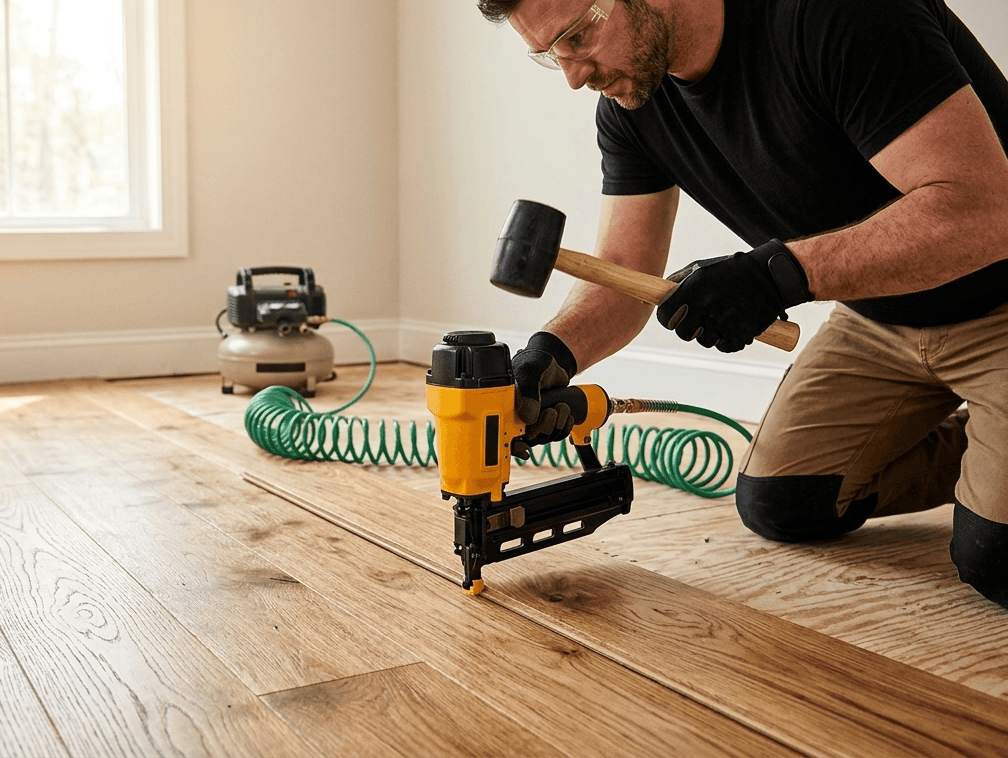
If you’ve ever spent a day on your knees installing a 500-square-foot oak floor, you know that your pneumatic flooring nailer is either your best friend or your worst enemy. A nailer that constantly jams or fails to set cleats properly isn’t just a nuisance—it’s a threat to the structural integrity of the floor.
In this guide, we’re going deep into the technical side of hardwood installation. You’ll learn the precise PSI settings needed for different wood species and how to minimize jam rates to keep your project moving smoothly.
The Physics of the Strike: Understanding PSI Requirements
Pneumatic floor nailers rely on compressed air to drive a fastener (cleat or staple) through dense hardwood and into the subfloor. Setting your compressor too low results in “proud” fasteners that block the next board, while setting it too high can crack the wood’s tongue.
Standard PSI Ranges
Most professional-grade pneumatic nailers operate between 70 PSI and 110 PSI. However, “set it and forget it” is a recipe for disaster.
- Softwoods (Pine, Cedar): 70–80 PSI.
- Standard Hardwoods (Oak, Hickory): 85–95 PSI.
- Exotic Hardwoods (Ipe, Brazilian Cherry): 100–115 PSI.
Pro Tip: Always perform a test drive on a scrap piece of your actual flooring and subfloor. You want the head of the cleat to sit just slightly below the surface of the tongue.
Why Nailers Jam: Common Culprits and Jam Rates
A “jam rate” refers to how often a fastener becomes lodged in the nose of the tool. High jam rates are usually not a “bad tool” problem, but a maintenance or compatibility problem.
1. Fastener Compatibility
Using generic fasteners in a brand-name nailer is the #1 cause of jams. For example, if you are using a Bostitch MIIIFN, ensure you are using high-quality Bostitch Flooring Cleats. Cheap cleats often have slight variations in thickness that cause the driving blade to catch.
2. Moisture and Lubrication
Pneumatic tools breathe air, and air contains moisture. If you don’t use a Pneumatic Tool Lubricant, the internal O-rings dry out, slowing the piston and causing the driver blade to strike the fastener at an odd angle, leading to a jam.
PSI Requirements by Wood Density (Janka Scale)
Different woods require different “punching power.” Use the table below as a starting point for your compressor settings.
| Wood Species | Janka Hardness Rating | Recommended PSI | Fastener Type |
| White Pine | 380 | 70-75 PSI | 15.5 Ga Staple |
| Engineered Oak | 1200 – 1360 | 80-90 PSI | 18 Ga Cleat |
| Solid Red Oak | 1290 | 90-100 PSI | 16 Ga Cleat |
| Hickory | 1820 | 100-110 PSI | 16 Ga Cleat |
| Bamboo (Strand) | 3000+ | 110-115 PSI | 18 Ga Cleat |
How to Reduce Jam Rates on the Job
- Clean the Nose Piece: Sawdust and factory wax from cleats can build up in the gate. Clean it every 500 square feet with a burst of compressed air.
- Check Compressor Recovery: If your compressor is too small, the PSI will drop as you nail quickly. This “low-pressure strike” is a primary cause of partial drives and jams. Use a 6-Gallon Pancake Compressor for consistent results.
- Drain Your Tank: Drain the water from your compressor tank daily to prevent internal rust from traveling into your nailer.
Conclusion
Mastering your hardwood floor nailer comes down to balancing pressure and precision. By matching your PSI to the specific Janka hardness of your wood and using high-quality, compatible fasteners, you can reduce your jam rate to near zero. Remember: a well-lubricated tool and a steady air supply are the keys to a floor that stays tight for decades.
FAQs
1. What is the best PSI for 3/4 inch solid oak flooring?
For most 3/4″ solid oak, 90 to 95 PSI is the sweet spot. If the subfloor is particularly thick or dense, you may need to bump it up to 100 PSI.
2. Why is my nailer splitting the tongue of the wood?
Splitting is usually caused by excessive PSI or using a fastener that is too thick. Switch to a thinner gauge cleat (like 18-gauge) or lower your air pressure by 5 PSI increments until the splitting stops.
3. Should I use staples or cleats for hardwood?
Cleats are generally superior for solid hardwood because they allow for the natural expansion and contraction of the wood. Staples provide more initial holding power but can sometimes back out or “crunch” during seasonal wood movement.
4. How often should I oil my pneumatic floor nailer?
Add 2-3 drops of pneumatic tool oil into the air inlet of the tool at the start of every work day. This keeps the internal piston and driver blade moving at maximum velocity.
5. Why does my nailer skip every few shots?
This is often a sign of a weak return spring or a dirty magazine. Ensure the “follower” (the part that pushes nails forward) isn’t stuck on sawdust or debris.